30 June 2025
From primate virus to pancreatic cancer treatment
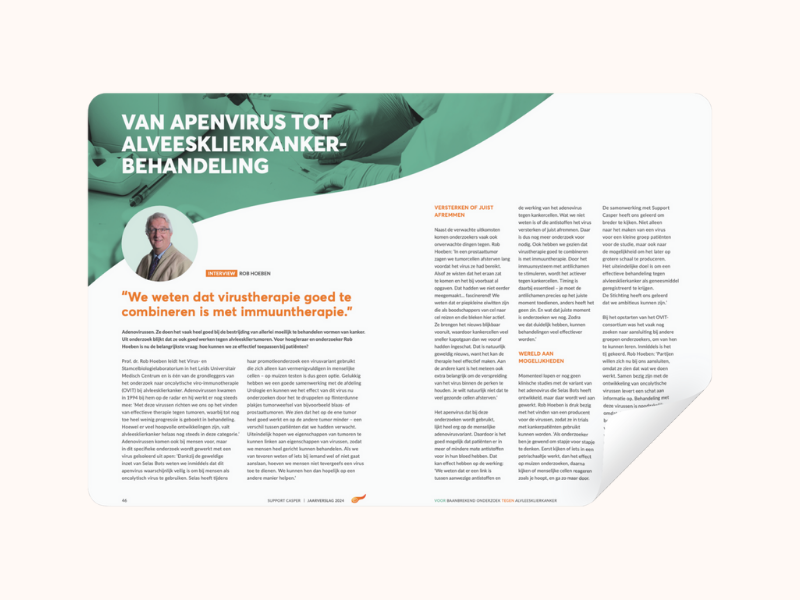 “We know that virotherapy and immunotherapy can work well together.”
Adenoviruses show promise against several cancers that are difficult to treat, including pancreatic cancer. For Professor Rob Hoeben, the central question is how these viruses can be used safely and effectively in patients.
Professor Hoeben leads the Virus and Stem Cell Biology Laboratory at Leiden University Medical Centre and helped establish the research programme into oncolytic viro-immunotherapy (OVIT) for pancreatic cancer. He has worked with adenoviruses since 1994. His team focuses on cancers for which treatment has made too little progress, and pancreatic cancer remains one of them.
Although adenoviruses also occur in humans, this project studies a virus isolated from primates. Thanks to the doctoral research of Selas Bots, the team now has strong indications that this variant could be suitable for use as an oncolytic virus in people. It reproduces only in human cells, so its effect cannot be assessed in conventional animal models. Working with the urology department, the researchers instead apply the virus to thin slices of tumour tissue from patients with cancers such as bladder and prostate cancer.
The response differs from one patient's tumour to another. The researchers hope to link characteristics of each tumour to those of the virus, allowing them to predict who is most likely to benefit. This could prevent patients from receiving a treatment that is unlikely to work and help clinicians choose another approach sooner.
Accelerating or slowing the response
Research also produces unexpected findings. In one prostate tumour sample, cancer cells began to die before the virus had reached them. The team discovered that small proteins acting as messengers between cells appeared to pass on a signal that accelerated the breakdown of cancer cells. That may make treatment more effective, but it also underlines the need to control the virus carefully and protect healthy tissue.
The primate adenovirus resembles a human variant closely enough that existing antibodies in a patient's blood may influence its effect. Researchers know there is a connection between these antibodies and the virus's ability to attack cancer cells, but they do not yet know whether the antibodies strengthen or weaken the response. The team is also studying how best to combine virotherapy with immunotherapy. Timing is crucial: immune-stimulating antibodies must be administered at the right moment to have the desired effect.
A world of possibilities
No clinical trial is currently under way with the adenovirus variant developed during Selas Bots's research, but preparations are being explored. Professor Hoeben is looking for a manufacturer capable of producing the virus to the standard required for trials in cancer patients.
Development proceeds step by step: first in laboratory cultures, then in suitable preclinical models and finally in human tissue. Working with Support Casper has also encouraged the team to plan beyond an initial small trial and consider future production at scale. The ultimate goal is to develop an effective pancreatic cancer treatment that can be authorised as a medicine.
When the OVIT consortium began, its researchers often sought out other groups to learn from their experience. Today, more organisations want to join the consortium because its approach is producing valuable results. Oncolytic viruses could be used on a broad scale, particularly for cancers with few effective alternatives. Once researchers understand how to use them safely and precisely, they could open up many new treatment options.