21 May 2025
Understanding the development of pancreatic cancer
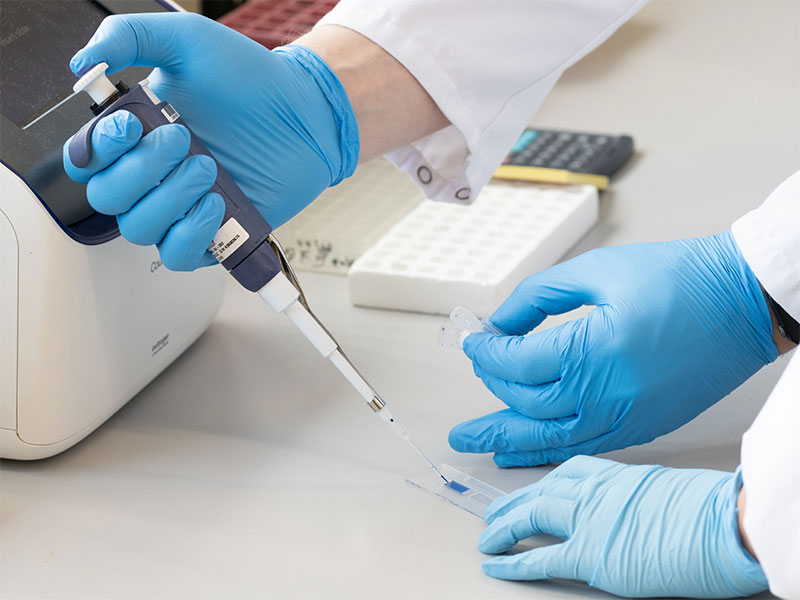
Our focus is on tumour cells and genes.
Clinician-researcher Anke Onnekink wants to understand at cellular level how tumours arise in the pancreas. Which gene mutations are involved? If the cancer returns after treatment, is it a delayed metastasis or a new tumour? In 2023, Support Casper guaranteed funding for this LUMC study of people with an inherited predisposition to pancreatic cancer. Anke hopes that a better understanding of how the disease develops will ultimately lead to more effective screening and treatment.
Pancreatic cancer still has a very poor prognosis, partly because it is often found at an advanced stage. Around 5–10% of patients have an inherited genetic predisposition. Anke and her colleagues, led by Professor Van Leerdam, are studying tumours from this group. She explains: “Genes are sections of DNA that help determine our appearance, how our bodies function and whether we are predisposed to certain diseases. Just as some people inherit a higher risk of breast cancer, others inherit a higher risk of pancreatic cancer. This is caused by a change in a gene, known as a mutation. People with a mutation in the CDKN2A gene have a 15–20% risk of developing pancreatic cancer. One particular mutation is relatively common in the Netherlands, and these are the people we see most often at LUMC. We offer them pancreatic screening so that any tumour can be detected and treated early. We want to understand why pancreatic cancer develops in this group, what the tumours look like and how they behave.”
Early stage
At LUMC, around 350 people in this high-risk group undergo pancreatic screening each year. In recent years, pancreatic cancer has been found in 36 of them. In most cases, the tumour could be removed surgically; five people later developed cancer in the pancreas again and required further treatment. Anke says: “Our study uses remaining tumour tissue from 28 patients. We analyse the tumour's DNA profile and compare it with normal pancreatic tissue from the same patient, helping us understand how healthy cells become tumour cells. Regular screening has shown us that tumours in people with this mutation can grow quickly. A scan may show a healthy pancreas, yet the next screening can reveal a two-centimetre tumour. We want to know whether these are especially aggressive tumours and how the immune system responds. Annual MRI scans allow us to observe pancreatic cancer at an early stage, and the similarity between people in this group makes it particularly valuable for research.”
Applying the findings more widely
Anke studies both tumour cells and genes. People in this group already carry one altered gene, but a second mutation is needed before pancreatic cancer develops. The researchers want to establish which additional mutations are involved and whether they differ from person to person. One in five people in the group develops pancreatic cancer again. Cell-level analysis can show whether this is a late recurrence or a new tumour. If they are new tumours, some patients may have such a high risk of recurrence that removing the whole pancreas could be considered rather than the tumour alone. That operation has a profound impact on a person's life, so robust evidence is essential. The study aims to improve screening and care for people with this mutation. The team also hopes to discover mechanisms that apply to people without an inherited predisposition, extending the benefits to many more patients.