20 November 2025
The latest developments in research and treatment of pancreatic cancer in the Netherlands
Report from the “Building the Future Together” symposium, held on 20 November 2025 at Grand Hotel Huis ter Duin in NoordwijkAuthor: Beatrice Lodde
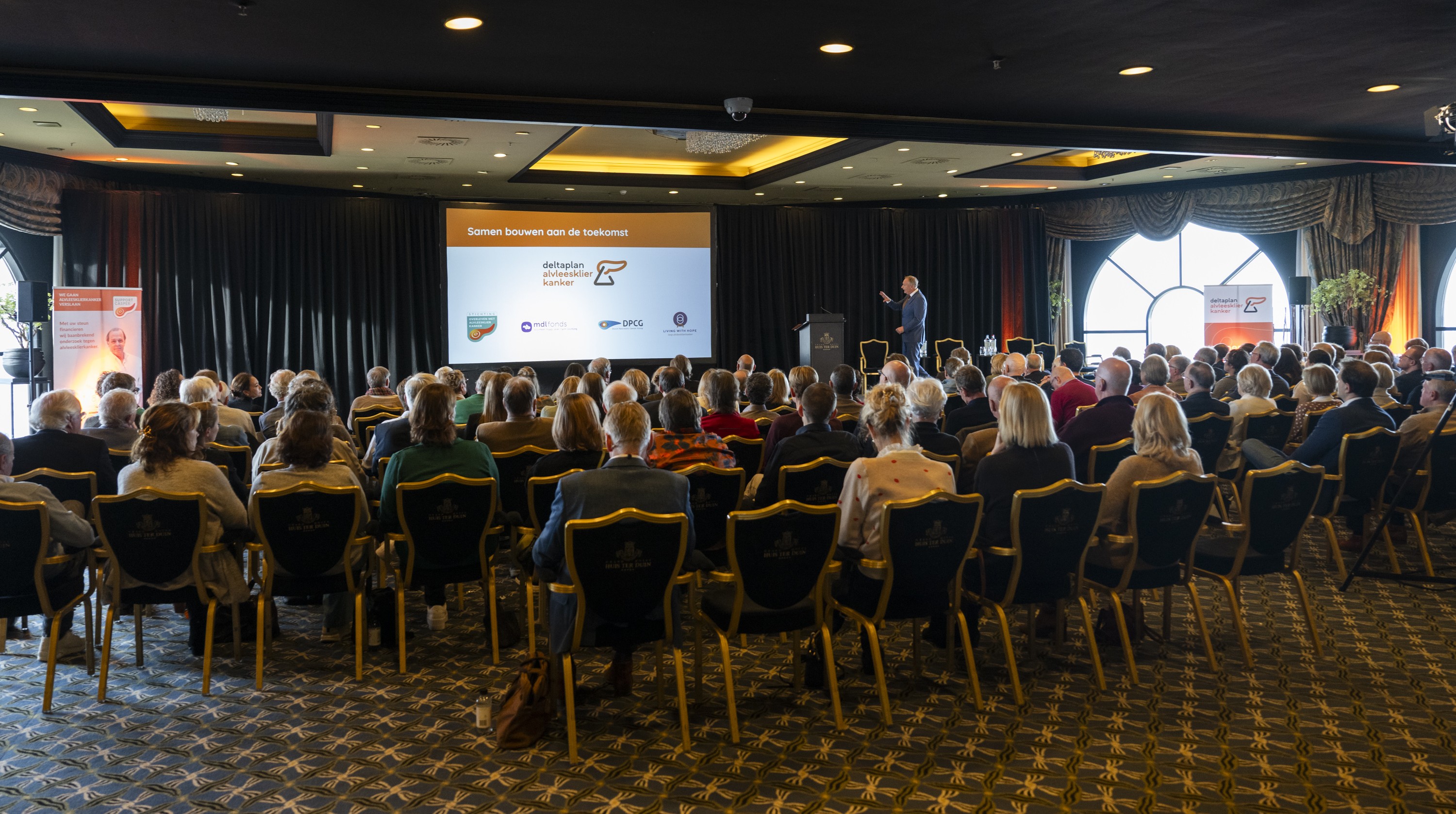
Longer survival with a good quality of life for everyone affected by pancreatic cancer: that is the shared goal of Stichting Overleven met Alvleesklierkanker (Support Casper) and Deltaplan Alvleesklierkanker. On World Pancreatic Cancer Day, 20 November 2025, they organised the “Building the Future Together” symposium at Grand Hotel Huis ter Duin in Noordwijk. The two organisations are joining forces to enable more research and make new treatments available to patients sooner. During the afternoon, leading pancreatic cancer specialists shared the latest insights into research and care.
Sjoerd Zwanenburg, director of Stichting Overleven met Alvleesklierkanker, opened the symposium. He explained that the foundation was established ten years ago to support the immunotherapy research led by surgeon Professor Casper van Eijck, who was also present. Through fundraising, the foundation enables scientifically innovative research into virotherapy and immunotherapy, with the aim of greatly improving both survival and quality of life.
Symposium host and television presenter Astrid Joosten noted that around 3,000 people in the Netherlands are diagnosed with pancreatic cancer each year. Although this is a substantial number of patients, close cooperation between hospitals is essential to gather enough data for robust scientific research.
Dr Bert Bonsing, surgical oncologist at Leiden University Medical Center, described Deltaplan Alvleesklierkanker: a national partnership between the Dutch Pancreatic Cancer Group (DPCG), patient platform Living With Hope, Stichting Overleven met Alvleesklierkanker and MDL Fonds. Bonsing chairs the DPCG, which brings together medical and nursing specialists in pancreatic cancer from 15 Dutch hospitals.
The DPCG contributes to scientific research, national quality registries, clinical guidelines and medical training. Deltaplan Alvleesklierkanker aims to ensure that new therapies developed with support from organisations such as KWF and Support Casper can ultimately be introduced throughout the Netherlands.
The DPCG also plays an important role in developing new and existing treatments into standards of care. This national coordination is crucial if innovative immunotherapies supported by Support Casper are to be applied safely and effectively.
Professor Hjalmar van Santvoort, a surgeon at the Regional Academic Cancer Centre Utrecht, then discussed quality registration through the Dutch Pancreatic Cancer Audit (DPCA). This national group collects and analyses data from everyone who undergoes pancreatic cancer surgery. Hospitals can compare outcomes such as serious complications and waiting times between diagnosis and treatment. “Doctors can compare their hospital's performance with that of other hospitals,” Van Santvoort explained. “This allows us to learn from one another and improve care.” The DPCA ultimately aims to cover every aspect of pancreatic cancer care, including endoscopy and chemotherapy, rather than surgery alone.
The Netherlands' international leadership in pancreatic cancer research and treatment was a recurring theme throughout the symposium. The six PREOPANC studies provide a strong example.
Dr Marjolein Homs, medical oncologist at Erasmus MC, explained the distinction between operable, locally advanced and metastatic pancreatic cancer. For operable disease, chemotherapy was traditionally given after surgery. It can also be given beforehand, known as neoadjuvant treatment. PREOPANC-1 found that patients who received gemcitabine and radiotherapy before surgery as well as chemotherapy afterwards were three times more likely to be alive after five years than those treated only after surgery. PREOPANC-2 and PREOPANC-3 are investigating neoadjuvant FOLFIRINOX; their final results are still awaited.
Professor Marc Besselink, a surgeon at Amsterdam UMC, used the case of a 68-year-old man to discuss treatment for locally advanced pancreatic cancer. Until recently, surgery was rarely possible and most patients received only palliative chemotherapy. The PREOPANC-4 implementation programme introduced a coordinated national approach. Four international experts trained Dutch surgeons in operating on locally advanced tumours, while a multidisciplinary panel of surgeons, oncologists and radiologists from different hospitals now discusses current cases online.
After the break, attention turned to current studies and experimental treatments. Pancreatic cancer often returns even after surgery and chemotherapy, so immunotherapy has become an important focus. Professor Hanneke Wilmink, medical oncologist at Amsterdam UMC, explained that chemotherapy or radiotherapy before surgery can break down cancer cells and release tumour antigens. The immune system recognises these proteins and sends T cells to the tumour, but the tumour can suppress their function. PREOPANC-5 is investigating whether immunotherapy can release this brake and allow the T cells to attack the cancer. Early results are promising.
Wilmink also discussed phenformin, a former diabetes medicine that was withdrawn because of side effects in people with impaired kidney function. Research suggests that it may be able to penetrate and destroy pancreatic tumours. Because phenformin is no longer commercially available, Amsterdam UMC, Erasmus MC, RARE-NL and Stichting Overleven met Alvleesklierkanker founded Pepper Therapeutics BV to develop it at a fair price. The tablets are expected to be ready in early 2026, allowing a patient study to begin.
Surgeon Dr Nigel Kooreman, who succeeds Van Eijck at Erasmus MC, described dendritic cell therapy. Dendritic cells coordinate immune responses and can encourage the immune system to attack a tumour. A patient's own dendritic cells are collected from the blood, exposed to tumour proteins in the laboratory and then returned in an activated state. PREOPANC-6, due to begin in 2026, will investigate whether this treatment after surgery and chemotherapy can improve survival.
Kooreman also discussed a personalised cancer vaccine being developed under the leadership of Dr Casper van Eijck Jr. Blood and tumour tissue collected during surgery are genetically analysed to identify proteins found on the tumour but not on healthy cells. These proteins form the basis of a vaccine tailored to that patient. The aim is to attack microscopic metastases left after surgery and reduce the risk of recurrence. In the longer term, the approach may also benefit people whose tumours cannot be operated on. NeOncoFRAx has been established to help keep the vaccine available at a socially responsible price.
Professor Hanneke van Laarhoven, medical oncologist at Amsterdam UMC, presented the Dutch Pancreatic Cancer Project (PACAP). Questionnaires are used to measure both quality of care and patients' quality of life. Although new treatments have extended survival for some patients, people whose quality of life is already poor before treatment tend to have a worse prognosis. Monitoring wellbeing may reveal ways to improve both length and quality of life through measures such as exercise or tailored nutrition.
The final speaker, Erasmus MC virologist Dr Bernadette van den Hoogen, presented work on oncolytic virus therapy. Healthy cells generally defend themselves well against viruses, whereas cancer cells often have weakened antiviral defences. A carefully selected virus can therefore infect and destroy cancer cells while also releasing tumour antigens that alert the immune system. Van den Hoogen's group uses a modified Newcastle disease virus, which causes disease in birds but is harmless to humans. Laboratory and animal studies show that the modified virus is effective. The team is now developing a clinical-grade production process so that patient studies can follow.
The symposium ended with questions from the audience. Sjoerd Zwanenburg thanked the speakers, donors and other supporters before closing the afternoon. Every presentation underlined the same message: collaboration and knowledge-sharing are essential if we are to improve the lives of people with pancreatic cancer.
Stichting Overleven met Alvleesklierkanker (Support Casper) initiates, funds and promotes patient-focused scientific research into new pancreatic cancer treatments, including immunotherapy and virotherapy. Its ambition is to help make effective and affordable treatments available by 2030.
Deltaplan Alvleesklierkanker is a national partnership between the Dutch Pancreatic Cancer Group, patient platform Living With Hope, Stichting Overleven met Alvleesklierkanker and MDL Fonds. It aims to improve existing treatments by pooling knowledge, comparing outcomes and translating research findings into clinical practice more quickly, so that patients throughout the Netherlands can benefit.